
Briefly about the task
The tightness of the fuselage is formed not by one element, but by a system of connections: joints of skin panels, rows of rivets and bolts, sealed contours of windows, doors and service hatches. Even a small through channel in a local area requires detection before the area is closed by the next assembly operation.
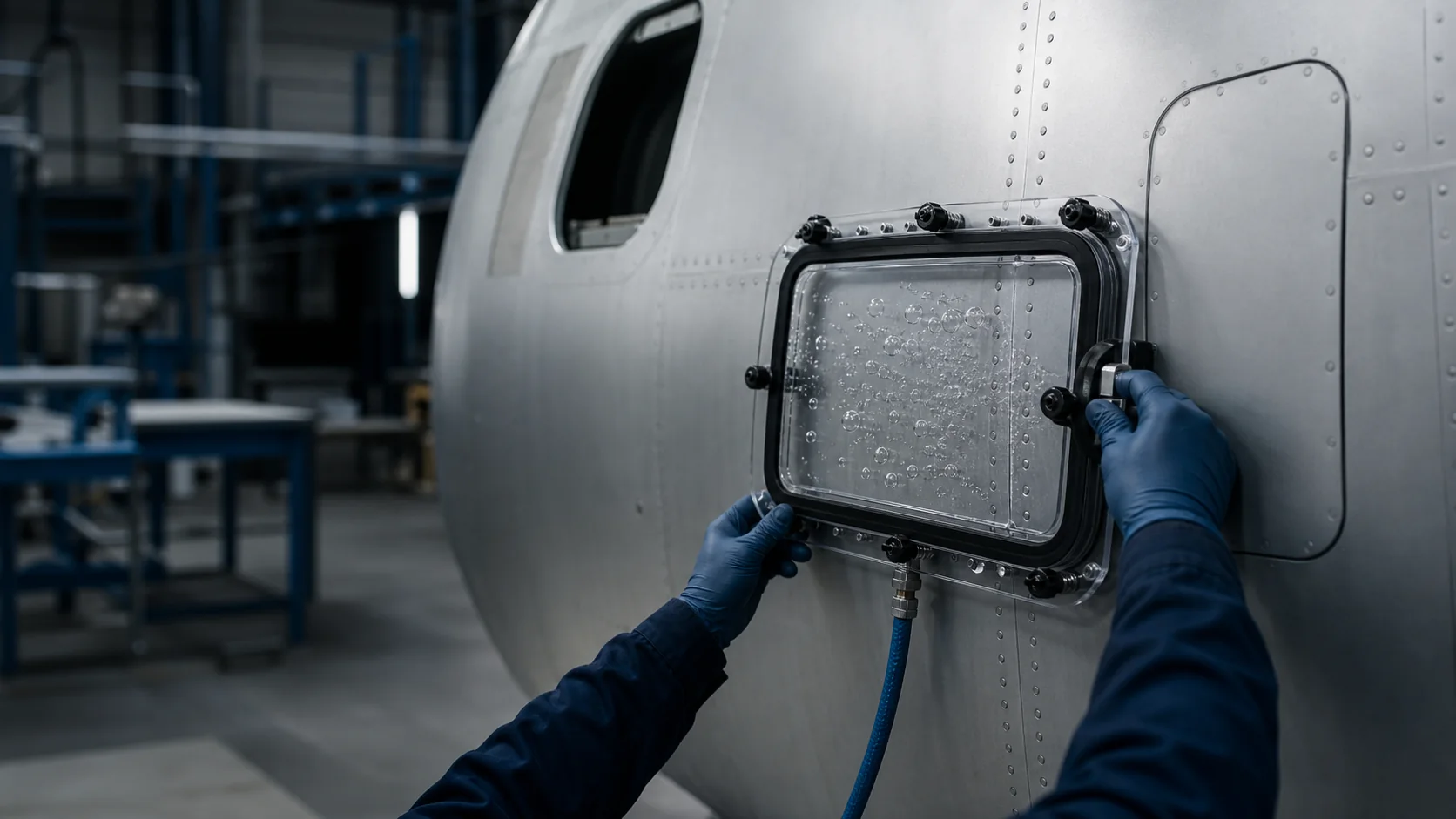
Bubble-vacuum control solves precisely a local problem. A foaming indicator is applied to the prepared surface, the area is covered with a transparent vacuum chamber and a vacuum is created. If air passes through the connection, persistent bubbles appear in the indicator, visible to the operator through the frame window.
The material shares the general industry scenario and information from TECH NK LLC about the completed delivery. An open source confirms the status of an enterprise, but not a specific control operation; product dimensions, process parameters and customer design data are not disclosed.
Delivery experience according to TECH NK LLC
NAZ "Sokol": framework for local control zones
According to TECH NK LLC, vacuum frames were supplied to the Nizhny Novgorod aircraft building plant "Sokol" to control fuselage skin elements before final assembly. The stated task included checking areas of rivet joints, as well as areas around windows, cargo doors and other openings.
For such a task, not only the length of the working chamber is important. The seal must follow the curvature of the panel, maintain contact adjacent to the rows of fasteners, and not block the operator's view of the controlled area. Therefore, some of the frames are designed according to the geometry of a specific area or according to an agreed template.
Exact standard sizes, product designations, controlled programs and test results refer to customer production information and are intentionally not given in the article.
What elements can be controlled
The composition of control operations is determined by the design and technological documentation of the enterprise. The vacuum frame is used where it is necessary to localize an area and visually detect a through discontinuity.
- panels and skin sections of the pressurized part of the fuselage;
- longitudinal and transverse rivet or bolted connections;
- panel joint areas and local repair areas;
- outlines of portholes and glazing;
- passenger, service and cargo door perimeters;
- covers and edgings of operational and technological hatches.
Why inspection is carried out before final assembly
Early control reduces the risk of returning to an already closed area. As long as the panel or assembly unit is accessible, the operator can sequentially check the connection, mark the location of the indication and transfer the area to eliminate the defect without dismantling adjacent structures.
The local chamber does not require creating a pressure differential across the entire fuselage. This is convenient for interoperational control of individual panels and assemblies, but does not replace the acceptance tests of the assembled product provided for in the program. The acceptance method and criteria are always specified by the current documentation of the enterprise.
What to Consider When Designing a Frame
For a flat process panel, a commercial frame may be suitable. On real skins, it is often necessary to take into account double curvature, protruding fastener heads, small width of the free zone and adjacent structural elements.
- radius and direction of curvature of the panel;
- width of the controlled connection and camera repositioning step;
- height of rivets, overlays and other protruding elements;
- available space for sealing on both sides of the seam;
- orientation of the fitting and ease of connecting the hose;
- required window transparency and overview of the display area.
Typical control sequence
Before use, the surface should be cleaned to the extent necessary to ensure proper seal sealing and indicator observation. Next, the area is covered with a foaming composition, a frame is installed, a given vacuum is created and the observation time is maintained according to the technological instructions.
The operator evaluates not the random foam from applying the composition, but the developing bubble indication at one point. After the inspection, the vacuum is removed, the frame is rearranged with the necessary overlap, and the results are recorded in the form accepted at the enterprise.
Method Boundaries
The bubble-vacuum method detects through-channels, but is not intended to detect all internal material and joint defects. For a comprehensive assessment, it is combined with other non-destructive testing methods in accordance with the design documentation.
The result is influenced by surface cleanliness, indicator quality, seal fit, vacuum stability and work area lighting. On a thin or sensitive panel, the mode should exclude unacceptable local load - it is assigned by the responsible customer service.
Questions and Answers
Is it possible to check the curved fuselage panel with a frame?
Yes, if the working geometry and frame seal are designed for the curvature of a particular area. Double curvature usually requires a special design based on a drawing, 3D model or template.
Is one frame suitable for rivet seam, porthole and door?
Generally not. Linear connections and closed loops differ in geometry, accessible sealing area and method of rearrangement, so different designs are selected for them.
Does local inspection replace testing of the entire containment volume?
No. This is a separate technological operation for local search for through discontinuities. The composition of the final tests is determined by the manufacturer's documentation.
What data is needed to make a frame?
The geometry of the controlled area, the radii of curvature, the width of the free surface around the joint, the location of the protruding elements and the requirements for operating vacuum are required.
Open sources and explanations
Technical context verified against open primary sources. Information about the equipment is given according to the provided photograph, drawing and description of the manufacturer; missing modes and test results are not conjectured.