Briefly about the task
The bottom of a vertical steel tank is assembled from sheets connected by welded seams. If, according to the project conditions, it is necessary to confirm the absence of through channels, the connection area can be checked using the bubble-vacuum method: an indicator composition is applied to the seam, the working area is covered with a frame and a local vacuum is created.
The method gives an observable indication directly above the monitored area, but the result depends not only on the vacuum installation. The geometry and condition of the frame, the fit of the seal, the preparation of the metal, the stability of the vacuum, lighting and a clear diagram for rearranging the camera are important.
Typical production task
Consistent inspection of long bottom seams
On a large bottom area, the operator moves the frame along the joint with a given overlap of the previous position. The length of the work area affects performance, while the width and profile of the frame affects the ability to securely install the seal near overlaps, seam intersections, or other protruding features.
For distributed work, installation with a sufficient length of hose is convenient: the pump can be left in a safe and stable point, and the operator only moves the frame. The final choice of installation and control procedure are determined according to the design and technological documentation of the facility.
How to choose a frame for the bottom of the RVS
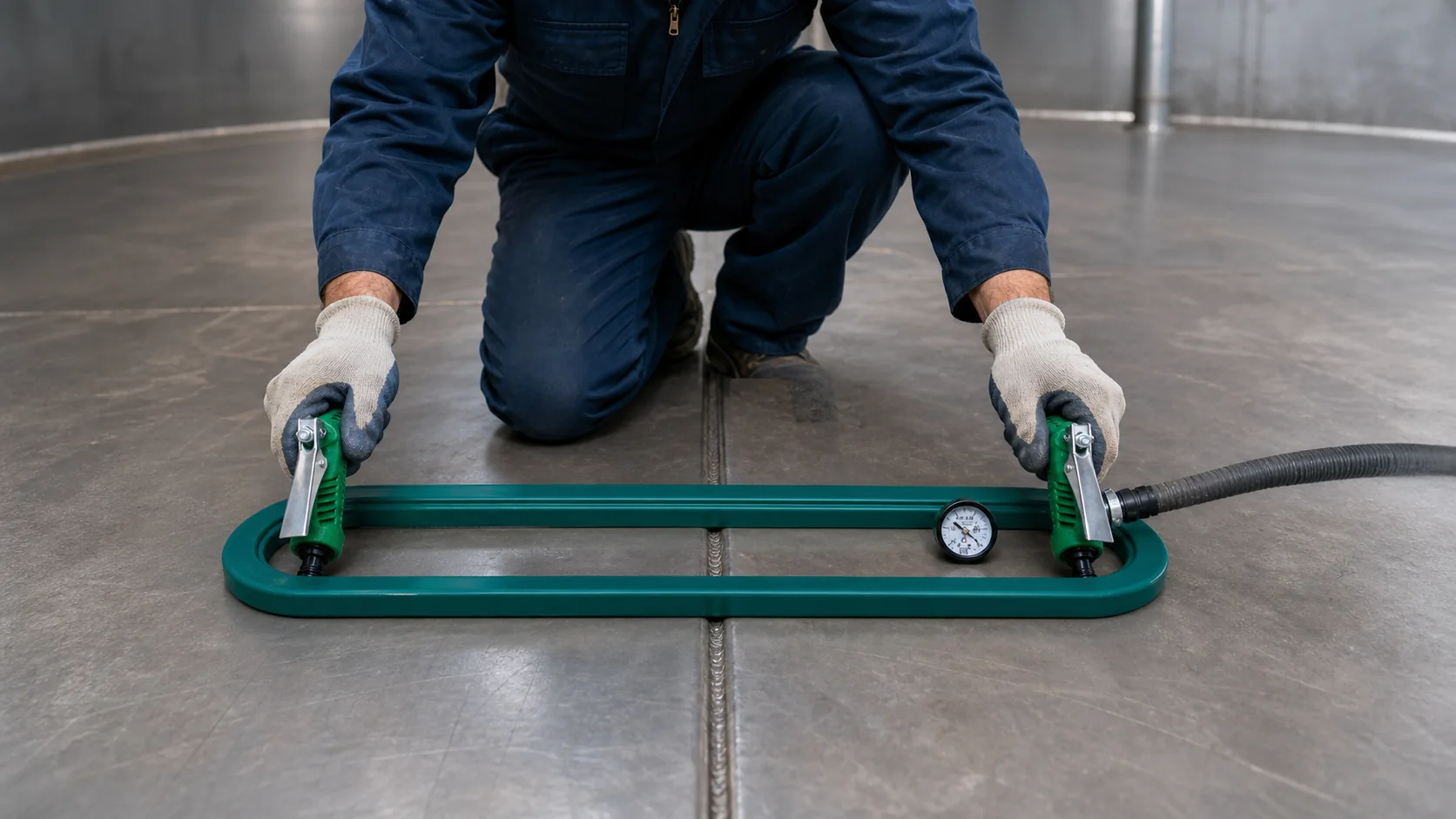
For straight butt welds on a flat sheet, use a flat frame. Its working window should overlap the controlled connection, and the sealing contour should be located on the free surface on both sides of the seam.
The longest frame is not always the most comfortable. In areas with intersections, sheet deflections, or limited access, a short design can provide a more stable fit.
- length of straight section between obstacles;
- width of the free zone on both sides of the weld joint;
- seam reinforcement height and surface differences;
- presence of overlaps, intersections and welded elements;
- frame weight and ease of rearrangement by the operator;
- required hose length to vacuum unit.
Surface preparation and camera installation
The surface is cleaned sufficiently to allow seal contact and visual inspection. Scale, metal spatter, loose corrosion and contaminants under the sealing contour can create air leaks.
The indicator composition is applied evenly within the observed area. The frame is installed across the seam and held by two standard handles. The hose is connected to the fitting of one of the handles on which the pumping control valves are located.
- check the integrity of the transparent window and seal;
- make sure the hose connection is secure;
- eliminate debris and pronounced gaps under the contour;
- provide lighting throughout the surveillance area;
- follow the mode and exposure time from the technological instructions.
How to eliminate gaps when rearranging
Before starting work, it is useful to divide the seams into sections and determine the direction of movement. Each subsequent installation of the frame must overlap the previous position by the amount established by the control technology.
Positions are marked on the bottom diagram or near the seam with an approved marker. Separately fix areas where a standard flat frame does not provide a fit: intersections of joints, pronounced deformations and abutments to structural elements.
- number the seams and the direction of passage;
- set constant overlap of neighboring positions;
- mark already checked areas;
- allocate areas for re-inspection after repair;
- record the mode and result.
What the method shows and doesn't show
Bubble-vacuum testing is designed to identify through channels in the surveyed area. A persistent, growing bubble indication at one point may indicate air passing through the connection.
The method does not replace the inspection of internal discontinuities in a welded joint. If the project involves visual measurement, ultrasonic, radiographic or other control, the vacuum frame is used as a separate operation as part of the approved technology.
Questions and Answers
What frame is needed for straight tank bottom seams?
Typically a flat frame is used, the working length and width of which correspond to the geometry of the seam and the free zone for compaction. For intersections and restricted areas, a separate design may be required.
Is it possible to check the entire bottom with one long frame?
Not always. A long frame increases coverage per installation, but is less adaptable to local unevenness and obstacles. The set is often formed from frames of different sizes.
Where should the hose be when working?
The hose is connected to the fitting of one of the standard frame handles. The operator holds and moves the frame using two handles on which the pumping valves are located.
Is the RUNDT-XR suitable for distributed underbody work?
The model on a trolley with a long hose is designed for site work, however, the suitability of the equipment is determined by the site conditions and customer regulations.
Open sources and explanations
Technical context verified against open primary sources. Information about the equipment is given according to the provided photograph, drawing and description of the manufacturer; missing modes and test results are not conjectured.