Briefly about the task
The girth weld runs around the circumference of the pipe, so the flat working surface of the chamber does not provide uniform contact with the metal. For a stable fit, a pipe frame with a concave base designed for the outer diameter of the product being tested is used.
Control is carried out in local positions: an indicator composition is applied to the joint, a frame is installed across the seam, a vacuum is created and the area is observed through a transparent window. Then the frame is rearranged around the circumference with technological overlap.
Typical production task
Check the entire circumferential weld in local areas
The working window of the tube frame covers only part of the circle. Therefore, before starting the inspection, the number of positions and the amount of overlap are determined, and the position of the pipe on the supports and areas to which the operator cannot safely bring the camera are taken into account.
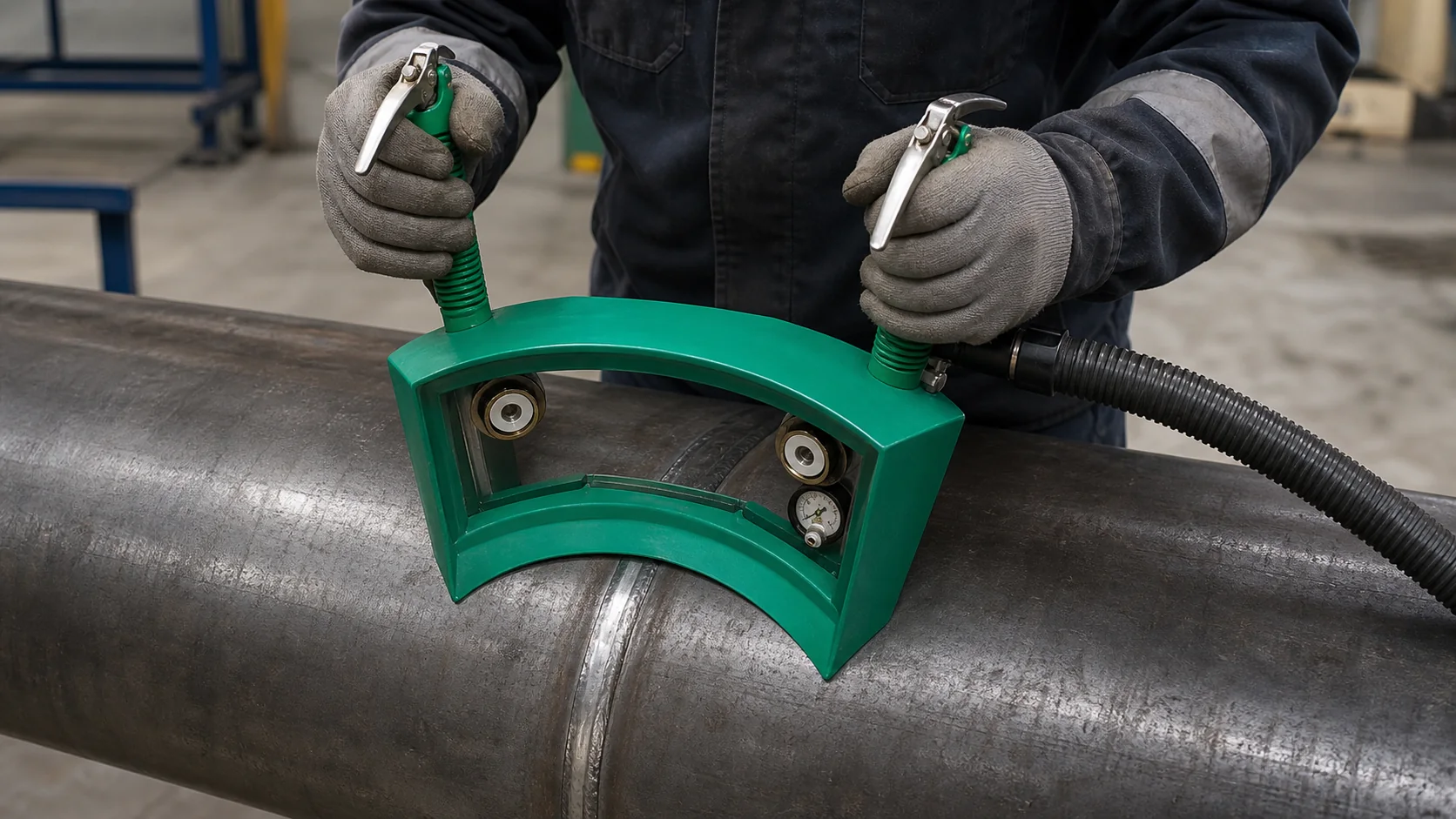
The frame is held by two standard handles. A vacuum hose is connected to one of them; valves located on the handles allow you to control the pumping and transfer of the chamber. The shape is chosen according to the actual outer diameter, and not just the nominal diameter.
Why is the outside diameter of the pipe important?
The working curvature should be close to the surface curvature. If the radius of the chamber is smaller or larger than required, the seal touches the pipe in separate zones, and a gap appears in other areas.
When ordering, specify the actual outside diameter, tolerance range and surface condition. Bends, transitions and products with variable radii are considered as a separate geometric problem.
- pipe outer diameter and tolerance;
- width and height of weld reinforcement;
- ovality and local surface deviations;
- coating, roughness and metal temperature;
- available section length along the pipe axis;
- connection position relative to supports.
Pipe vacuum frame arrangement
The real RUNDT tube frame has a rigid green profile, a transparent observation window and a concave working part under the cylindrical surface. Two protruding handles serve simultaneously to hold the chamber and control pumping; the hose is connected to the fitting of one of the handles.
During operation, the operator carries and presses the frame by the handles. Do not use a hose to move the camera or place stress on the transparent window and measuring elements.
- concave working surface along the radius of the pipe;
- continuous sealing contour;
- transparent window above the control area;
- two handles with pump-out valves;
- hose connection;
- vacuum gauge for monitoring vacuum.
Circumferential weld inspection sequence
The surface is cleaned in the seam area and along the compaction path. The indicator composition is applied within the observed area, the frame is installed symmetrically relative to the connection and the mode specified by the technological instructions is created.
After exposure, the vacuum is removed and the frame is moved to the next position. In order not to leave unchecked zones between the ends of the working window, adjacent positions are performed with overlap.
- check that the frame radius matches the pipe diameter;
- inspect the window, seal, handles and hose;
- ensure uniform fit along the entire contour;
- observe the developing bubble indication;
- record each position and result;
- plan separately to monitor the inaccessible lower zone.
Limitations and selection criteria
The tube frame confirms the absence or presence of a through channel within the tested area, but does not characterize all internal discontinuities in the weld joint. The composition of mandatory control methods is established by design and regulatory documentation.
If one set is to be used on several pipe diameters, the acceptable fit range must be assessed in advance. For noticeably different diameters it is safer to use separate frames.
Questions and Answers
What diameter should I specify for making a pipe frame?
The actual outer diameter of the pipe being inspected with tolerance is required. The conditional passage in itself does not determine the working curvature of the chamber.
Is it possible to check pipes of different diameters with one frame?
Within the confirmed fit range only. If there is a significant difference in diameters, separate versions are required.
How does the operator hold the tube frame?
For two protruding standard handles. They contain pumping valves, and a vacuum hose is connected to a fitting on one of the handles.
Is the tube frame suitable for a longitudinal seam?
Longitudinal and circumferential welds require different work area orientation and chamber geometry. The design is selected according to the connection drawing and the direction of the seam.
Open sources and explanations
Technical context verified against open primary sources. Information about the equipment is given according to the provided photograph, drawing and description of the manufacturer; missing modes and test results are not conjectured.